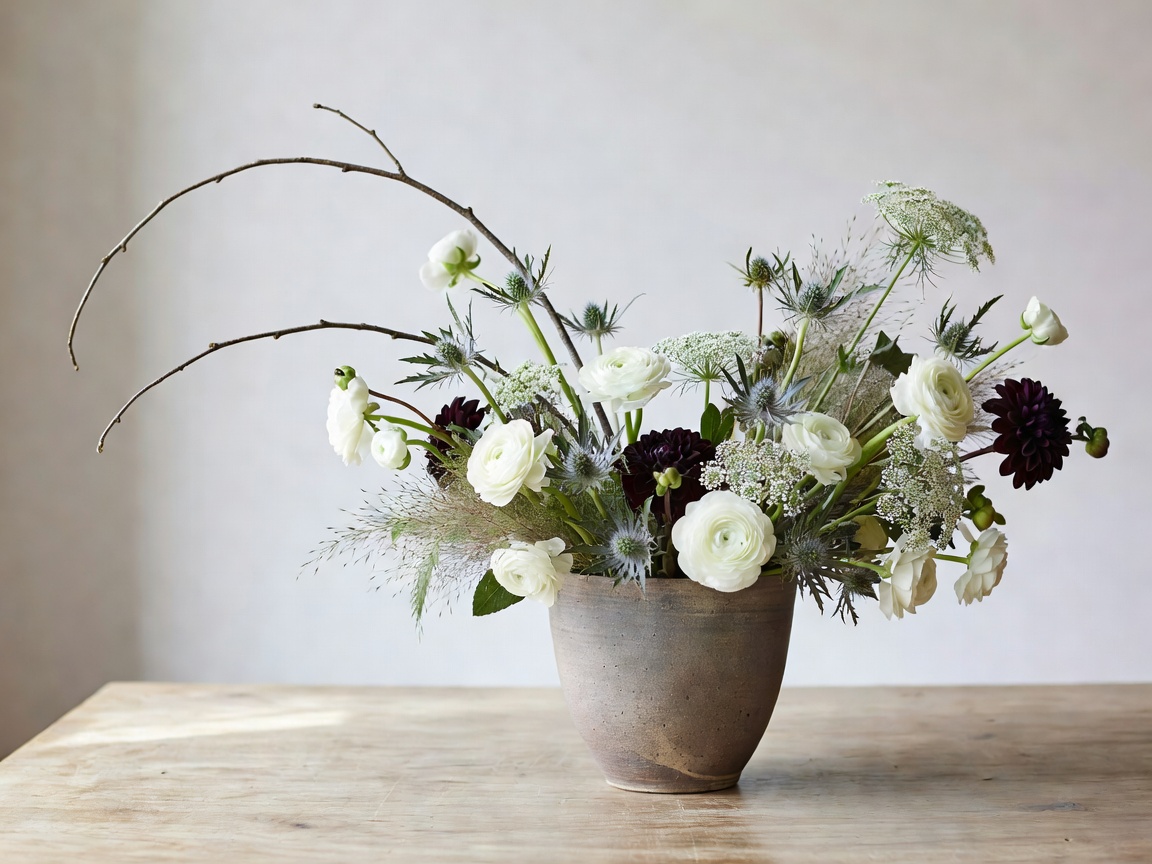
Danish floral design occupies a unique position in contemporary European floristry. Where traditional French styles emphasize dense hemispherical symmetry and Victorian arrangements prioritize riotous opulence, the Nordic approach focuses on structural restraint, airy spatial rhythm, and deep reverence for the natural lifecycle of plant material.
The Philosophy of 'Uperfekt' (The Imperfect)
At the center of Scandinavian floral culture is an appreciation for plants as they grow in wild conditions. Stems with natural bends, asymmetric branching, irregular flower heads, and faded petals are intentionally celebrated rather than discarded. Designers frequently draw direct inspiration from Denmark’s windswept coastal dunes, boggy woodlands, and overgrown rural hedgerows.
This aesthetic connects closely with the broader principles of Danish modernist design: functionality, honesty in materials, and uncluttered silhouettes. A bouquet is not treated as an artificial sculpture imposed upon flowers, but as a temporary frame that highlights the intrinsic growth habit of each botanical element.
Core Principles of the Nordic Bouquet
- Air and Negative Space: Flowers are never packed tightly against one another. Space is preserved between blossoms so that each head can be viewed individually without visual competition.
- Asymmetric Balance: Rather than mirrored left-right designs, compositions balance weight through contrast. A heavy single bloom low on one side may be countered by an extended, light willow branch reaching high on the opposite flank.
- Layered Textural Diversity: Arrangements integrate matte seed pods, rough bark, soft velvety foliage (such as lamb’s ear), and delicate open petals in an interplay of sensory surfaces.
- Tonal and Desaturated Color Palettes: Saturated jewel tones are generally tempered with washed out greens, silvers, earthen ochres, butter tones, and muted coral accents.
Vessel Pairing: Ceramics and Hand-Blown Glass
The container is regarded as an equal partner in Scandinavian floristry. Danish studios work extensively with local ceramicists producing unglazed stoneware, rough terracotta, or minimalist smoked glass vases. The texture of the vessel is chosen to echo the matte surfaces of seasonal stems.
Pros and Cons of Nordic Meadow-Style Floristry
| Characteristic | Advantages | Considerations / Trade-offs |
|---|---|---|
| Airy Construction | Improves air circulation; delays stem rot; creates architectural shadow | Fewer total stems can look fragile if displayed in oversized rooms |
| Foraged Wood & Seed Pods | Durable structural base; remains attractive after blossoms fade | Woody stems require separate water conditioning and stem splitting |
| Asymmetric Geometry | Dynamic view from all angles; modern silhouette fits sleek interiors | Requires careful physical counter-weighting in light vases |
| Natural Stem Curvature | Honest representation of plant growth; poetic informal movement | Difficult to standardize for mass-produced commercial event floristry |
Practical Application in Copenhagen Studios
In studios across Vesterbro and Nørrebro, florists often dispense with traditional floral foam entirely. Instead, they stabilize stems using reusable brass kenzan (pin frogs), coiled chicken wire, or criss-crossed woody branch structures. This physical method dictates the visual language: flowers stand with clean posture in clear water, displaying stems, submerged leaves, and cut ends as integral elements of the complete composition.